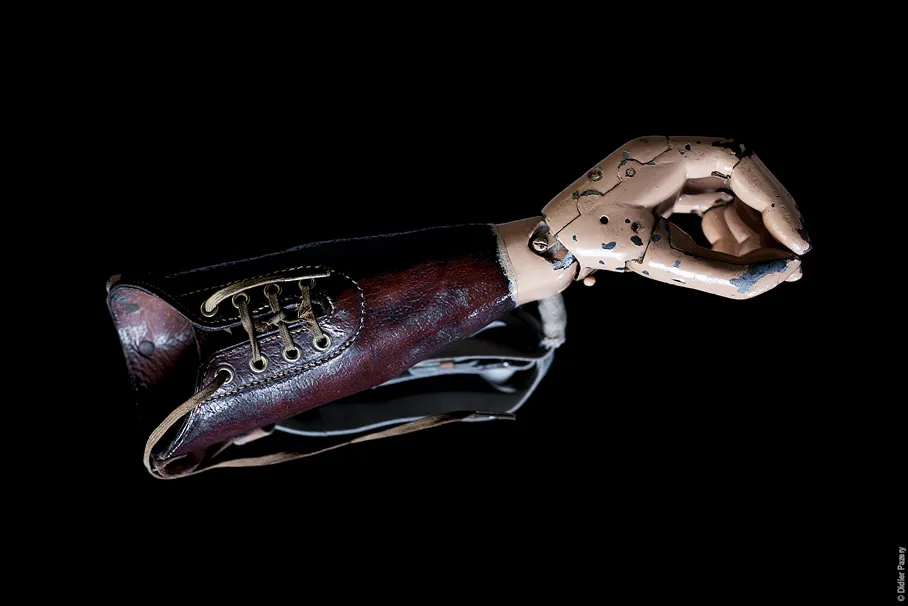
Prosthetic forearm with an articulated hand, known as an “American prosthesis”
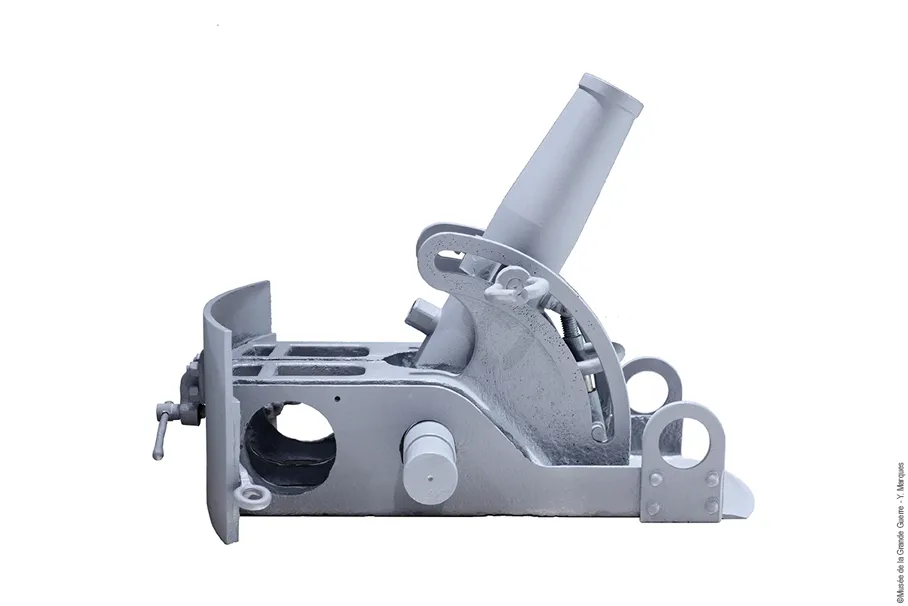
By the end of 1914, under pressure from German artillery that was better suited to trench warfare, the French army developed and manufactured short-tubed, arcing trajectory mortars. The first 58 mm mortar reached the front on 18 January 1915. An improved version arrived in April, the “no. 2”, and would remain the most widely-used throughout the conflict.
This mortar was dubbed the “crapouillot” because of its toad-like shape. The powder was placed in the tube, and the projectile was a bomb with fins and a cylindrical tail that slotted into the tube. The tail functioned like that of an arrow, maintaining the trajectory, with the point first, to ensure the precision of the shot and explosion upon impact. The 58 mm mortar fired various projectiles weighing between 16 and 45 kg: the lightest at a range of 1,400 m, and the heaviest 350 m. The mount’s design allowed shots at angles of between 45° and 80° – practically vertical.
“Crapouillot” T n. 2 58 mm mortar, 1916-1918, metal, 101 x 56.5 cm. Inventory no.: 2010.39.1.