Wagons of the World War
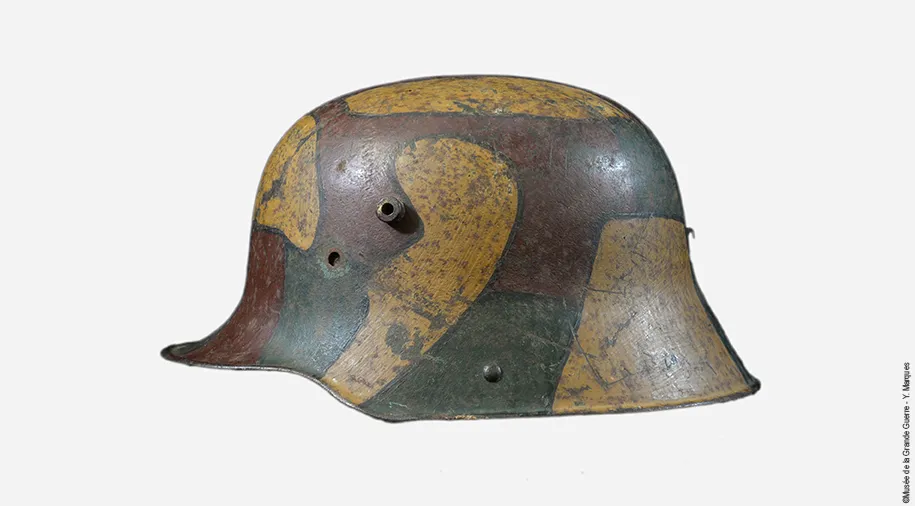
The silhouette of the German infantryman changed radically in 1916. Troops were now equipped with highly enveloping steel helmets known as Stahlhelme, from the German Stahl (steel) and Helm (helmet). These helmets had wide smooth surfaces and were painted in “Feldgrau” (field grey) colour. However, these painted surfaces led to considerable reflection of light, making German soldiers conspicuous on the battlefield.
On 7 July 1918, General Ludendorff ordered camouflaging of the helmets through the application of paint. The camouflage’s finish had to be matte in order to avoid any reflections, and the choice of colours was dictated by the terrain and the season. Helmets had to be painted with areas of flat colours in angular shapes, alternating light and dark shades and separated with a line of black paint. This directive was applied directly within each unit, allowing each soldier to express their own creativity and making each helmet a unique piece.
Stahlhelm, German helmet (1916 model with 1918 regulation camouflage), 1918, metal, 17.5 x 32.5 x 24.5 cm. Inventory no.: 2006.1.681